About the Frameworks
Two original frameworks developed through doctoral research at Pepperdine University's Graduate School of Education and Psychology. Both are intellectual property of Eileen Hernandez and shape the Digital Philanthropy Divide series.
The DIA Protocol™
Participatory Ownership
Community Governance — Direct involvement in decision-making and resource allocation.
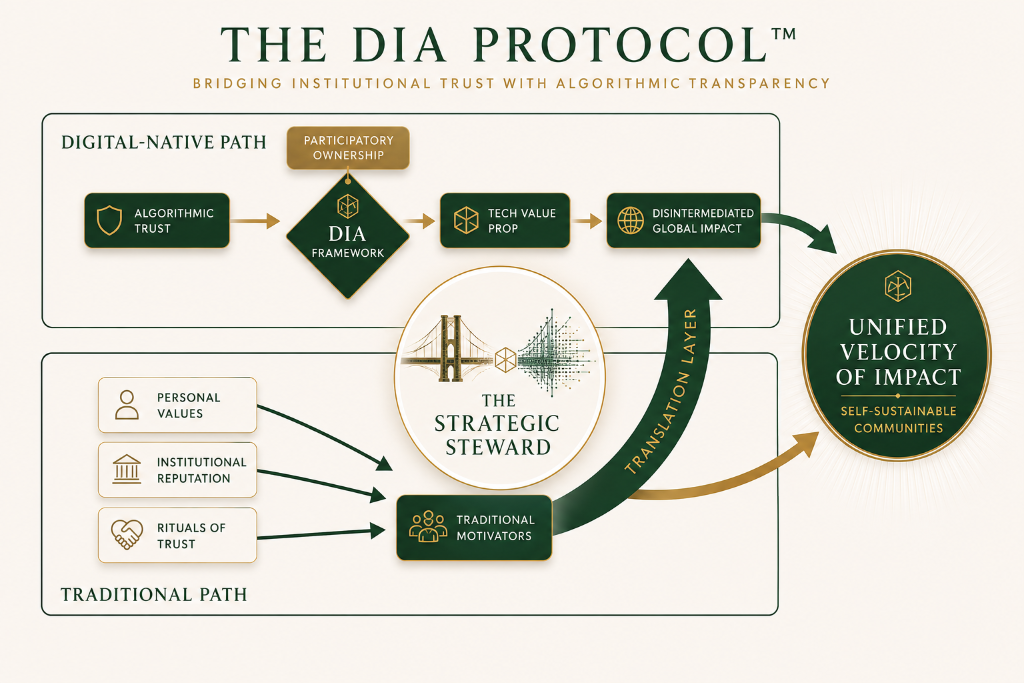
The Decentralized Impact Alignment (DIA) Protocol is a four-dimension framework extending Donor Motivation Theory (DMT) to account for the giving behavior of crypto-native and digital-native donors. It was developed through doctoral research at Pepperdine University's GSEP and is the intellectual property of Eileen Hernandez.
Pillar 1
Algorithmic Trust
The confidence a giving system earns through verifiability rather than reputation, meaning the rules and records a donor relies on can be inspected rather than taken on faith.
Pillar 2
Participatory Ownership
Direct involvement in decision-making and governance. Shared responsibility and collective agency over how resources are allocated and how impact is created.
Pillar 3
Technological Value Proposition
The strategic worth of a giving technology lives in the rail and the infrastructure rather than in the instrument that first rode it.
Pillar 4
Disintermediated Impact
Whether a gift can reach and confirm its outcome without a chain of intermediaries sitting between the donor and the result.
Named Constructs
Bridge Event
A single policy or jurisdictional decision that routes capital and giving behavior onto new rails for years.
Digital Philanthropy Divide
The gap between institutional and digital-native giving infrastructure.
The DIA Protocol is the subject of ongoing doctoral dissertation research and forthcoming peer-reviewed publication. Hernandez, E. (2025). Extending Donor Motivation Theory: Integrating Decentralized Impact Alignment for the Digital Age. Pepperdine University, GSEP.
Impact Velocity
Impact Velocity is defined as the rate, efficiency, and equity with which institutions convert available resources into measurable outcomes for vulnerable populations. It has three dimensions:
Efficiency
How much outcome an institution produces per unit of resource.
Equity
Whether those outcomes reach the most vulnerable.
Rate
How quickly institutional improvements translate into better outcomes on the ground.
Impact Velocity is a regime-agnostic construct, meaning it applies to governments, nonprofits, and corporate giving programs regardless of their political or organizational structure. It was introduced in cross-national governance research examining 164 countries and is being developed as a formal index for philanthropic investment assessment.